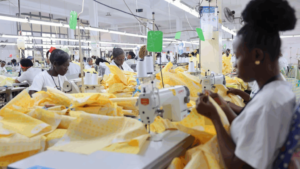
There is a silent killer plaguing the garment manufacturing industry in Ghana that does not get talked about enough. This cancer – attention to detail – has been plaguing the industry for decades, and up till today, no comprehensive solution has been devised to remedy it.
As someone who owns a garment manufacturing factory in Takoradi, and having spoken to several local fashion houses and production managers, I can confidently say this is a critical issue we battle on a daily basis. It often leads local fashion brands losing faith in producing locally and resorting to manufacturing in countries such as China, Portugal, and Turkey against their own wishes.
This begs the question: how did this come about? Ghanaians are globally recognised for their creativity. When you look at the intricate artistry of kente weaving—beautifully preserved by master weavers in Bonwire, for example—what becomes evident is a craft steeped in extraordinary precision and discipline. The irony is that the same nation capable of producing such excellence struggles with consistent finishing standards in modern garment factories and local ateliers.
So why do workers struggle with perfect hems, aligned seams, straight stitches, and consistent finishing?
Many argue that the problem stems from:
Inadequate pre-production training
Inconsistent in-line quality control
Weak post-production finishing standards
These are valid observations. Research conducted by international agencies confirms a persistent skill-education misalignment in many developing and low-income countries. Reports by the World Bank press release on TVET systems and labour mismatch, and the World Bank/ILO/UNESCO global study on TVET systems, highlight the fact that formal training often fails to meet labour market needs. These documents describe how outdated curricula, weak employer engagement, inadequate teacher support, and limited practical training hinder graduates’ readiness for real work environments.
With all that being said, I believe the root causes of these issues go deeper.
- Cultural Attitudes Toward Workmanship — The “Bare Minimum” Problem
In many factories, quality is seen as the responsibility of the quality control officer—not the operator. Once a worker completes their assigned seam, the mindset is often: “My part is done.” Whether that seam is slightly uneven, or the tension is off, or the stitch line drifts by a millimetre—those details are left for someone else to correct.
Over time, this creates a culture where the bare minimum becomes acceptable:
If the garment is wearable, it passes.
If the stitch holds, it is “fine.”
If the customer does not complain loudly, it is deemed satisfactory.
Within the global manufacturing landscape, mere adequacy is the enemy of competitiveness and, ultimately, survival.
This is not about blaming workers. It is about confronting a deeper cultural conditioning where doing just enough to avoid reprimand is considered satisfactory. Precision is not systemically rewarded; adequacy is tolerated.
Compare this to production cultures in companies like Toyota, where quality is embedded into production systems. Through principles like Jidoka – the principle of building quality into the process rather than inspecting for it at the end – and continuous improvement, every worker is responsible for stopping defects at the source. There is no “bare minimum.” There is only “right the first time.”
Quality in such systems is built in—not inspected in at the end.
In many Ghanaian factories, operators assume:
The line supervisor will catch it.
The quality controller will fix it.
The finishing unit will cover it up.
This mindset compounds defects down the production chain, increasing the frequency of rework, slowing delivery times, and eroding client confidence.
The cost of these cultural attitudes is enormous and at times catastrophic:
Higher rejection rates
Increased production time
Reduced profitability
Loss of international orders
Ultimately, local brands and clients lose trust in local production capacity and move their production elsewhere.
If we are honest, this “bare minimum” culture is not limited to garment factories. It reflects a broader workplace challenge across sectors—where compliance replaces craftsmanship and adequacy replaces excellence.
Until we confront this cultural norm, technical training alone will not solve the quality problem.
- Educational Misalignment with Industry Needs — Curriculum Not Designed for Factory Realities
Ghana has reputable institutions such as Takoradi Technical University and Accra Technical University, yet there remains a persistent disconnect between what is taught in schools and what is required on factory floors. Curricula often focus more on theory than on real, practical production skills.
This is not unique to Ghana. According to a joint World Bank / ILO / UNESCO report, TVET systems in many developing countries are ill-equipped to meet evolving labour market needs, suffering from outdated content, weak incentives for providers, and inadequate engagement with employers. Graduates often lack practical skills, industry exposure, and competencies relevant for work environments, including structured production processes like line systems, quality checkpoints, and standard operating procedures—skills essential in garment manufacturing. (International Labour Organisation)
Furthermore, a World Bank press release highlights how many TVET systems “focus on what they know how to provide… but not what students or firms need,” including key practical, cognitive, and industry-aligned skills. (World Bank)
In garment production, operators must work within tightly defined systems:
Line-production sequencing
Standardized sewing times
Inline quality verification
Tolerance-based specifications
In reality, many students graduate with classroom theory but limited exposure to these realities. Curricula rarely incorporate factory simulations, real-world line-work experience, or collaborative modules designed with industry partners.
A recent skills supply assessment in Ghana’s Ashanti Region found that TVET curricula do not align with employer needs, leading to significant skills mismatches and weak practical competence among graduates entering the workforce. (UNICEF)
This mismatch means companies must spend scarce resources retraining new hires—if they can afford to hire them at all.
To bridge this gap, the education system must:
Co-design programs with garment factories
Introduce compulsory internships on real production lines
Teach students how line systems operate
Focus on quality assurance processes
Equip graduates with documented competency standards
Until curricula reflect the actual requirements of modern garment production, the industry will continue to struggle with poor quality outputs—not because of a lack of potential, but because training systems are misaligned with workplace realities.
Solutions: Fixing the Culture and the Classroom
If we are serious about building a globally competitive garment manufacturing industry in Ghana, we must address these two foundational issues:
The normalization of “bare minimum” performance.
An education system that does not reflect the operational realities of factory production.
Technical upgrades alone will not solve this. We need cultural reform and structural alignment.
- Rebuild a Culture Where Excellence Is the Standard — Not the Exception
If “just enough” is tolerated, mediocrity becomes institutionalised.
To dismantle the bare minimum culture, factories must deliberately redesign what is rewarded, measured, and tolerated.
a) Make Quality an Individual Responsibility
Every operator should sign off on their work.
Introduce self-inspection checkpoints before garments move down the line.
Track defects by operation—not just by final garment.
Display daily defect dashboards publicly on the factory floor.
When defects are traceable, ownership increases.
b) Reward Precision, Not Just Speed
In many factories, fast workers are praised—even when their work requires rework later.
That must change.
Incentivize zero-defect production runs.
Recognize operators with consistent quality accuracy.
Tie bonuses to quality metrics, not just output volume.
What leadership celebrates becomes culture.
c) Train for Craftsmanship Mindset
Operators should understand:
Why 1cm seam allowance matters.
How 2mm misalignment affects garment symmetry.
How repeated “small” errors compound into brand rejection.
Quality must be connected to pride, not punishment.
The goal is to shift from: “I’ve finished my part.” to “I’ve finished it properly.”
- Redesign TVET and Fashion Curriculum Around Factory Realities
One of the biggest structural gaps is that many graduates are trained like independent tailors—not industrial production operators.
Modern garment factories operate on line systems, not single-garment construction.
Students must be trained for the environment they are entering.
a) Teach the Line Production System
Curricula should include:
How production lines are structured
Operation breakdown and task specialization
Standard minute value (SMV) concepts
Inline quality control procedures
Workflow efficiency and bottleneck identification
Students should experience simulated production lines before graduation.
Working in a factory line requires:
Speed with consistency
Coordination with upstream and downstream operators
Discipline within standardized processes
These are rarely taught explicitly.
b) Embed Mandatory Factory Immersion
Industrial attachments should not be optional or symbolic.
They must:
Be structured with learning objectives.
Include rotation across departments (cutting, sewing line, finishing, QC).
Require evaluation from factory supervisors.
Exposure to real production pressure changes mindset.
c) Co-Design Curriculum With Industry
Factories and institutions must collaborate.
Industry leaders should:
Sit on curriculum advisory boards.
Deliver guest lectures.
Provide real production case studies.
Help design competency-based assessments.
If graduates cannot operate confidently within a line system from day one, the curriculum has failed.
- Strengthen Factory Systems to Support Cultural Change
Even with mindset reform and better education alignment, factories must institutionalise systems that sustain excellence.
Develop written Standard Operating Procedures (SOPs).
Define tolerance charts for every garment style.
Implement inline QC instead of relying only on final inspection.
Conduct root cause analysis for recurring defects.
Systems protect standards when personalities leave.
- Leadership Must Model Intolerance for Mediocrity
Cultural change does not begin with operators. It begins with leadership.
If managers:
Overlook sloppy finishing to meet deadlines,
Accept “it’s okay” responses,
Avoid difficult conversations about quality,
Then the bare minimum culture survives.
But if leadership consistently communicates: “We do not produce average work,” and backs that statement with structure and accountability — Standards rise.
Ghana does not lack creativity. We do not lack talent. What we lack is a systems-driven culture of precision.
Kente weaving is proof that discipline and excellence are part of our DNA. The question is whether we are willing to modernise that excellence into structured industrial systems.
If we solve the quality control problem, we unlock not just better garments—but export competitiveness, job creation, and global respect for “Made in Ghana.”
And that conversation is long overdue.
–
The author, Nana Brenu, is a Fashion Designer | Global Consultant | Creative Educator | Championing African Fashion Narratives, Empowering Creativity, Culture, Sustainability & Innovation in Fashion.