Air pollution is causing widespread violations of fundamental human rights, a United Nations expert has told the Human Rights Council, warning that billions of people are being exposed to dangerous air every day.
Addressing the council in Geneva, Astrid Puentes Riaño said the scale of exposure is nearly universal.
“Today 99% of the global population breathe polluted air that poses a risk to our health and our lives,” she said.
Her remarks to the United Nations Human Rights Council outlined the deep and far-reaching consequences of air pollution on human health, dignity and survival. She linked polluted air directly to violations of the rights to life, health and a safe environment.
“Science clearly and irrefutably concludes that air pollution impacts all organs in our body and during all stages of life,” she said, adding that the effects begin even before birth and continue across a person’s lifetime.
Air pollution contributes to strokes, heart disease, cancer, respiratory illnesses and developmental delays in children. According to the World Health Organization, between six and eight million people die every year from exposure to polluted air, while many more lose years of healthy life.
Global data reinforces the scale of the problem.
According to the World Health Organization, between six and eight million people die every year from air pollution-related causes. The State of Global Air 2024 report, published by the Health Effects Institute, puts that figure even higher, estimating that air pollution was responsible for 8.1 million deaths globally in 2021 alone, making it the second leading risk factor for death worldwide, surpassing poor diet and tobacco. That same year, more than 700,000 of those deaths were children under the age of five, representing 15% of all global deaths in that age group.
The AQLI 2025 report, produced by the Energy Policy Institute at the University of Chicago, confirms that particulate pollution, the fine invisible particles known as PM2.5, remains the world’s greatest external risk to human health. It is set to reduce the global average life expectancy by 1.9 years, making it deadlier than smoking, which costs 1.7 years of life on average. If humanity could simply meet the WHO’s clean air standard, it would collectively reclaim 15.1 billion years of life.
Puentes Riaño highlighted sharp inequalities in exposure, with the highest risks concentrated in low- and middle-income countries.
“The highest and most dangerous levels of air pollution occur in low and middle income countries… often near marginalized communities,” she said. “92% of premature deaths related to air pollution occur in these countries.”
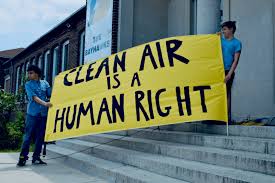
Communities living near highways, industrial zones and extractive sites face the greatest risks, alongside children, older people, pregnant women and those with pre-existing health conditions. She described clean air as central to equality and justice.
For Ghanaians, the data hits close to home. According to the AQLI 2025 report, fine particulate pollution is costing the average Ghanaian nearly 0.8 years of life expectancy, roughly nine months stolen from every life. The data, drawn from 2023 satellite monitoring, shows that Ghana’s average PM₂.₅ level stood at 12.91 micrograms per cubic metre, more than double the WHO’s safe limit of 5 µg/m³.
The human cost is rising. While WHO estimates from 2019 put pollution-related deaths at about 28,000 Ghanaians per year, the latest State of Global Air figures put that number at over 32,000, more than 82 deaths every single day. Ghana’s death rate from air pollution stands at 177 per 100,000 people, more than ten times higher than in high-income countries. About 5,900 of those deaths are children and young people under the age of 20.
One in every three heart disease deaths in Ghana is linked to air pollution. Upper respiratory tract infections remain the country’s leading cause of illness. The sources are well-known: an ageing fleet of vehicles belching black smoke through city streets, widespread open waste burning, industrial emissions, and domestic cooking over biomass and coal, many of the same drivers the Rapporteur identified as fuelling the global crisis.
There is a sliver of hope. Ghana is among a handful of countries where new air quality monitors have been installed under the Air Quality Fund, an initiative of the University of Chicago’s Energy Policy Institute, a first step toward giving policymakers the data they need to act. And Ghana passed its first-ever comprehensive air quality management regulations in 2025. But the country still has no specific national standard for annual PM2.5 levels, a gap that urgently needs closing.
Puentes Riaño said the crisis can be addressed through coordinated action, pointing to known sources such as fossil fuel use, transport emissions, open burning and industrial activity.
“This is a crisis that is preventable and solvable,” she said, urging governments to strengthen regulations, expand air quality monitoring and invest in cleaner energy systems.
“Contrary to the myth that solutions to air pollution are too expensive, evidence shows that investing in improving air quality yields a return of seven times or more on the investment.”
She also criticised global spending patterns, noting that far more funding goes into fossil fuel subsidies than efforts to reduce air pollution.
States have a legal obligation to act, she added, including protecting vulnerable populations and preventing environmental harm before it occurs.
“No other person, including children, older people, pregnant people, people with disabilities, and those living in poverty, should continue suffering from a situation that is completely preventable,” she said.
“Breathing clean air is part of the human right to a healthy environment… to make sure that everyone, especially children, can finally breathe clean air,” she said.
Her address adds to growing international pressure on governments to treat air pollution as a central public health and human rights issue, with calls for faster and more decisive action.
_
This story was a collaboration with New Narratives. Funding was provided by the Clean Air Fund which had no say in the story’s content.