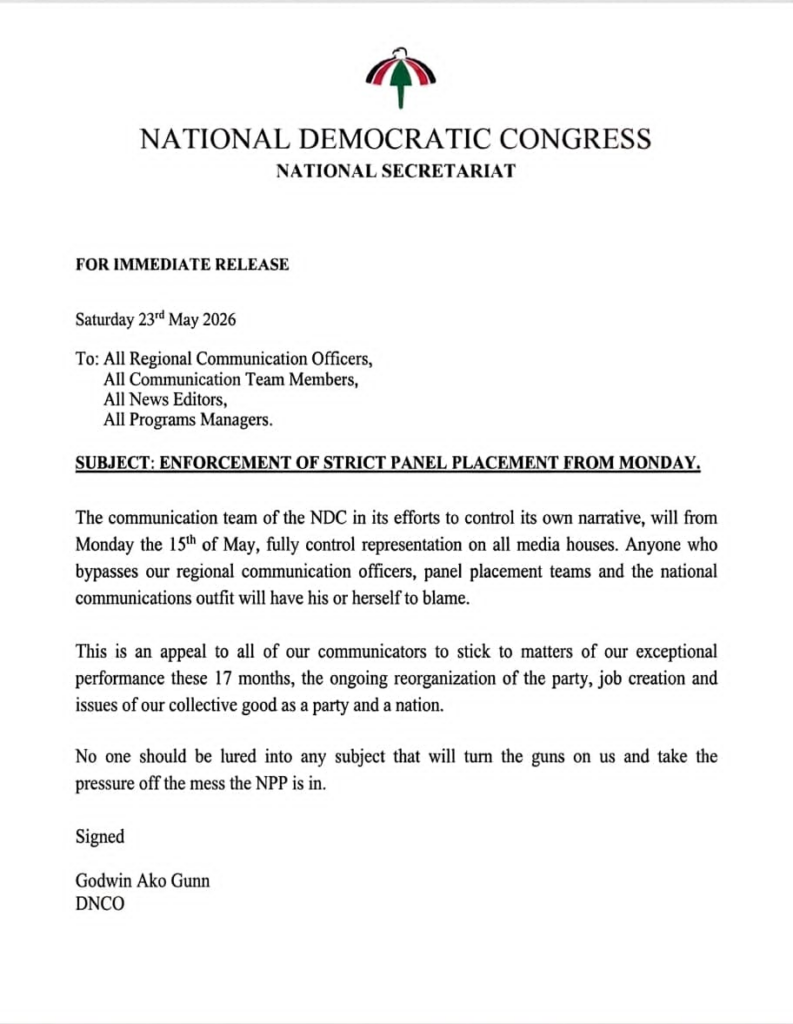
The National Democratic Congress (NDC) has announced plans to strictly control who speaks for the party on radio and television programmes across the country as part of efforts to “control its own narrative”.
In a statement issued by the party’s National Secretariat on Saturday, May 23, the NDC directed all regional communication officers, communication team members, news editors, and programme managers to take note of the new arrangement.
The directive, signed by Deputy National Communications Officer (DNCO) Godwin Ako Gunn, said the policy on panel representation would be fully enforced from Monday.
“The communication team of the NDC, in its efforts to control its own narrative, will from Monday… fully control representation on all media houses,” the statement said.
The party warned members against bypassing officially approved communication structures when seeking media appearances.
“Anyone who bypasses our regional communication officers, panel placement teams and the national communications outfit will have himself or herself to blame,” the statement added.
The move appears aimed at ensuring message discipline within the opposition party as it seeks to strengthen public confidence and maintain focus on issues it considers politically beneficial.
According to the statement, communicators are expected to concentrate discussions on what the party described as its “exceptional performance” over the past 17 months, as well as the ongoing reorganisation of the NDC, job creation efforts and matters affecting the national interest.
“This is an appeal to all of our communicators to stick to matters of our exceptional performance these 17 months, the ongoing reorganisation of the party, job creation and issues of our collective good as a party and a nation,” Mr Gunn stated.
The NDC also cautioned its representatives against engaging in discussions that could shift public attention away from challenges facing the governing New Patriotic Party (NPP).
“No one should be lured into any subject that will turn the guns on us and take the pressure off the mess the NPP is in,” the statement said.
Political analysts say the decision reflects growing efforts by political parties to maintain tighter control over public messaging, especially in a highly competitive media environment where party representatives often make conflicting statements.