
How Publican AI Sees Your Declaration: The A–B–C Model Explained
Part I — Before the Legal Debate
In the weeks following the April 2026 deployment of the Publican AI-assisted valuation and classification support system by the Customs Division of the Ghana Revenue Authority, the atmosphere within Ghana’s trading community became unusually tense.
Freight forwarders, importers, customs house agents and sector operators suddenly found themselves operating within a new environment where declarations that historically moved through established discretionary channels now appeared to face algorithmic resistance. What unsettled the market was not merely the presence of artificial intelligence within customs operations. International trade systems across the world are increasingly moving toward AI-assisted risk management. The real concern was uncertainty. Traders and agents did not fully understand what the system was attempting to achieve, how it “thought,” or what exactly triggered the dramatic valuation movements many began experiencing.
That uncertainty was compounded by the tone and interpretation of an early correspondence issued internally within the Ghana Revenue Authority, which many market participants understood to mean that the outputs of Publican AI had become effectively binding. Operationally, this created the impression that customs officers had lost the ability to exercise judgement and that the traditional principles of documentary reconciliation had been overtaken by machine-generated valuation outcomes.
Subsequent engagement with stakeholders, however, particularly clarificatory communication emerging later, sought to moderate that perception and restore proper operational context. Those later engagements attempted to reposition the system not as a replacement for customs discretion, but rather as a valuation-assistance and risk-support mechanism designed to aid officers in identifying declarations that required deeper scrutiny. THAT DISTINCTION MATTERS ENORMOUSLY.
The issue before the market today is therefore not simply “AI versus traders.” The more important question is how the confidence logic of the system is being operationalized in practice. The conceptual A–B–C corridor model unearthed during engagements around the deployment helps explain this far more clearly.
Understanding the A–B–C Corridor
At the centre of the Publican AI philosophy lies a confidence corridor.
The model does not necessarily search for one rigid “correct” value for every transaction. Rather, the system appears to work within a range of commercial plausibility built from historical patterns, documentary consistency, known trade behaviours, declared classifications and observed market outcomes.
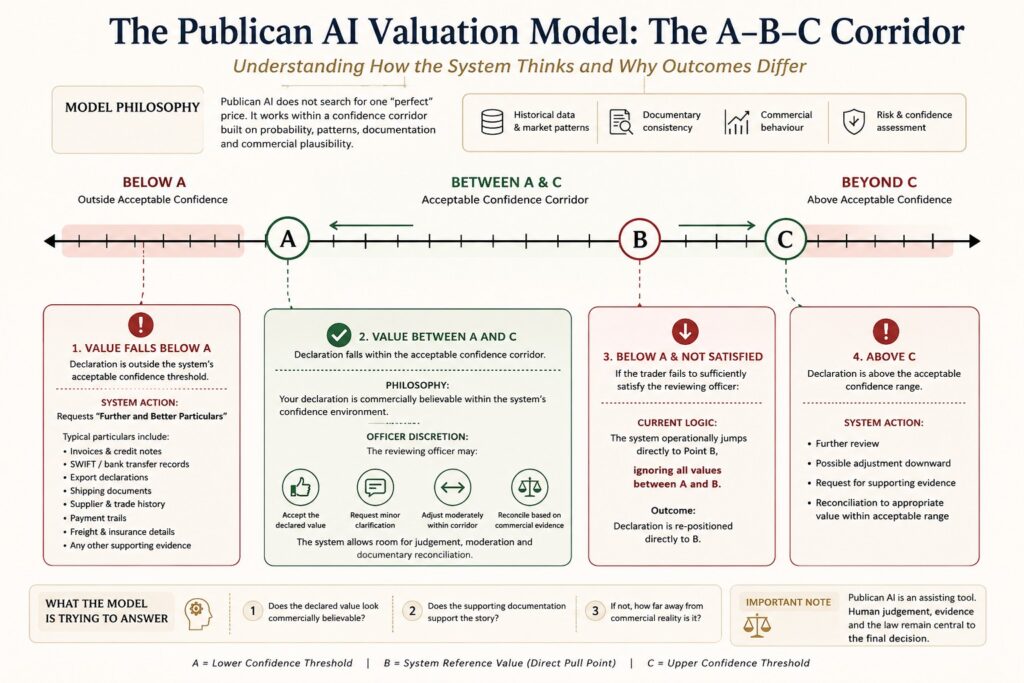
The attached conceptual framework simplifies this logic into three principal reference points:
- Point A
- Point B
- Point C
The philosophy behind the model is that when a trader’s self-assessed customs value falls within the acceptable corridor between A and C, the declaration remains commercially believable within the system’s confidence environment.
In practical terms, the declaration has not fundamentally broken the model.
Within that corridor, the reviewing customs officer still retains discretion. The officer may:
- accept the declared value entirely,
- request minor clarification,
- moderately adjust the value within the corridor,
- or reconcile the declaration against supporting commercial evidence.
The important point is that the declaration is still considered capable of explanation.
The model is effectively saying:
“The declared value still falls within a commercially understandable range.”
This is an important distinction because AI systems in customs administration do not operate like simple calculators. They function more like confidence engines.
They examine:
- historical transaction patterns,
- documentary harmony,
- classification consistency,
- payment structures,
- supplier behaviour,
- trade history,
- and commercial plausibility.
The system therefore operates around probability and evidentiary confidence rather than a single universal price point.
This is particularly important in international trade because commercial reality is rarely uniform.
Why the Market Became Disturbed
The tension that followed the deployment was driven largely by perception.
Many traders and agents initially interpreted the system to mean:
- “the AI has fixed the value,”
- “the officer cannot move from the machine’s number,”
- or “self-assessment no longer matters.”
That interpretation naturally produced fear because customs valuation under international trade law has historically been built around transaction value principles and documentary examination, not machine-imposed pricing.
The first operational signals from the deployment environment appeared, in the eyes of many practitioners, to reinforce those fears.
Suddenly, declarations that traders believed were commercially defendable were being repositioned upward in ways that appeared abrupt and insufficiently moderated. Because the market did not yet understand the confidence-corridor philosophy behind the system, many interpreted the outcome as arbitrary automation.
Subsequent clarification from within the GRA environment therefore became critical because it attempted to restore an important principle:
Publican AI is intended to assist decision-making, not eliminate customs judgement.
That clarification was necessary because customs valuation cannot become entirely robotic without creating serious commercial distortions.
International trade is too dynamic for that!
What Happens Below A
The more sensitive part of the model begins when a trader’s declared value falls materially below Point A.
Within the philosophy of the system, this movement signals that the declaration has moved outside the model’s acceptable confidence threshold.
At that stage, the system appears to transition from ordinary assessment mode into verification mode.
In other words, the system begins asking:
“Can the trader sufficiently prove why this declaration sits materially outside expected commercial behaviour?”
This is where requests for further and better particulars emerge.
Those particulars may include:
- SWIFT transfer confirmations,
- bank transaction records,
- invoices,
- export declarations,
- shipping bills,
- payment trails,
- supplier verification,
- trade history,
- freight consistency,
- and broader commercial documentation.
The logic behind this stage is understandable from a customs risk-management perspective. If the system encounters a declaration materially below established confidence thresholds, it naturally seeks additional evidence before accepting the declared value. In principle, that process is not inherently unreasonable.
The operational challenge arises afterwards.
Why the Jump to B Creates Anxiety
The central concern presently experienced by many traders and agents is not merely that additional evidence is requested.
The deeper concern is what appears to happen when the reviewing officer remains unsatisfied after those additional particulars are provided.
Operationally, the current logic appears to pull the declaration directly toward Point B.
This is where the discomfort begins.
From the perspective of traders and agents, the system appears at times to bypass all possible intermediate values between A and B and instead reposition the declaration immediately toward B itself.
The trader therefore experiences the outcome not as moderated reconciliation, but as a sharp valuation migration.
That distinction matters psychologically and commercially.
The market can generally tolerate scrutiny. What creates anxiety is the perception that once the declaration falls below A, the system effectively says:
“If you cannot sufficiently defend your value, we move you directly to B.”
This creates the impression that commercial gradation has disappeared.
The concern therefore is not necessarily artificial intelligence itself. The concern is whether the operational logic presently allows enough room for proportional reconciliation between:
- documentary explanation,
- commercial nuance,
- and machine confidence thresholds.
That is where the ongoing debate truly sits.
The Difference Between AI Assistance and AI Dictation
There is an important conceptual difference between:
- AI-assisted customs administration,
and - AI-determined customs administration.
An assisting system helps officers identify risk, inconsistency, or abnormality. The human officer still interprets commercial reality.
A dictating system effectively converts machine confidence into operational command.
The clarificatory posture later adopted by stakeholders within the GRA environment appears to recognize this distinction and attempts to restore balance by emphasizing that officers still possess discretion and that documentary reconciliation remains relevant.
That clarification was important because international customs valuation systems are not designed to function as fully deterministic pricing engines.
Under globally accepted valuation principles, customs administrations are expected to examine:
- the truth,
- the accuracy,
- and the completeness of declarations.
That is materially different from simply imposing machine outputs.
Why Commercial Reality Is Never Perfectly Uniform
One of the greatest misunderstandings in valuation environments is the assumption that identical products must always carry identical prices.
Real-world commerce does not behave that way.
Two traders may import the same category of goods under entirely different commercial conditions.
A shipment may reflect:
- distressed inventory disposal,
- long-standing supplier relationships,
- seasonal liquidation,
- end-of-line stock clearance,
- bulk purchasing advantages,
- damaged packaging discounts,
- freight consolidation arrangements,
- credit structures,
- or timing-based market opportunities.
A pharmaceutical consignment acquired under emergency inventory reduction will not necessarily carry the same commercial reality as a standard market purchase.
A textile importer clearing residual factory stock may legitimately present values different from mainstream commercial channels.
Consumer electronics acquired during supplier restructuring exercises may produce pricing patterns that differ significantly from ordinary trade flows.
This is precisely why customs valuation systems globally still require human judgement alongside technological assistance.
It is also important to note that engagements with the Commissioner-General of the Ghana Revenue Authority indicate that used vehicles are presently not captured within the operational deployment environment of the Publican AI model. That clarification is important because much of the public discussion has incorrectly generalized the system across all import sectors.
The Importance of Officer Discretion
The most stable customs systems in the world are not those that eliminate human discretion. They are those that discipline discretion with better data.
That distinction is critical.
The objective of AI in customs administration should not be to replace judgement, but to improve the quality of judgement.
A well-calibrated AI-assisted valuation environment should therefore:
- identify anomalies,
- strengthen documentary reconciliation,
- improve consistency,
- reduce arbitrary treatment,
- and help customs officers focus attention where risk genuinely exists.
At the same time, the system must preserve room for commercial explanation because trade itself is not mathematically uniform.
The long-term success of Publican AI will therefore depend not merely on computational strength, but on how intelligently the confidence corridor between A and C is operationalized in practice.
Concluding Reflection
The current debate surrounding Publican AI is, in many respects, a debate about transition. Ghana’s customs environment is moving from a predominantly manual judgement architecture into a data-assisted risk environment. That transition was always going to create friction.
The important task now is not panic, but understanding.
The A–B–C corridor model helps traders and agents appreciate that the system is fundamentally attempting to measure commercial plausibility, documentary consistency and evidentiary confidence. Where declarations remain within the acceptable corridor, the system still leaves room for moderation and officer discretion.
The tension emerges primarily when declarations fall materially below acceptable confidence thresholds and the operational response appears to migrate too aggressively toward predetermined valuation positions.
Understanding that philosophy is the first step toward a more informed conversation about the future of AI-assisted customs governance in Ghana.