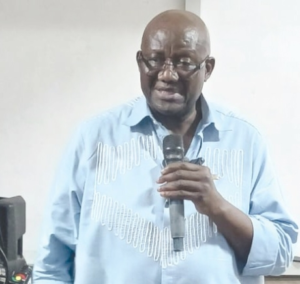
Former Head of Public Affairs at the Ghana Cocoa Board (COCOBOD), Fiifi Boafo, has described the government’s Nkoko Nkitinkiti programme as a waste of state resources, arguing that its design is incapable of creating sustainable poultry businesses.
Speaking on JoyNews’ AM Show on Friday, July 10, Mr Boafo questioned the rationale behind distributing only a few birds to beneficiaries, saying the initiative lacked a sound business model.
“The Nkoko Nkitinkiti is a complete waste of state resources, nothing more, nothing less,” he said.
According to him, giving beneficiaries two birds could not possibly achieve the programme’s objective of expanding local poultry production.
“If you say that you are giving people chickens to rear and you give them two, what are they going to use them for? If not for them to just enjoy them, what business can anybody create with two? What sort of model is that?” he questioned.
Mr Boafo also challenged the government to account for the programme’s performance since its introduction.
“What was the target? What did we seek to realise from this? What has been the result after a year?” he asked.
He further questioned whether the initiative had delivered any measurable economic benefits.
“Has it reduced imports, and by what percentage? What are the savings that we’ve made? How much money have we invested in it, and what benefit have we received as a result?” he said.
The former COCOBOD spokesperson argued that the programme had departed significantly from what was initially presented to the public, claiming the number of birds allocated to beneficiaries had steadily reduced.
“What was the business model around this whole Nkoko Nkitinkiti and how many chickens do we give to people? Initially, we were told 50, reduced to 15, now to two,” he said.
He cited what he described as complaints from beneficiaries in the Ahafo Region as further evidence that the programme was failing to meet expectations.
“So it just demonstrates the point that what the government claimed it was going to do totally failed. They did not realise it.”
Questioning the commercial viability of the initiative, he argued that a beneficiary could not establish a meaningful poultry enterprise with only a handful of birds.
“Ask yourself, five chickens, what are you going to do with that? Which business are you going to run with five?” he asked, describing the initiative as “just an unnecessary use of state resources.”
Mr Boafo also broadened his criticism to other government promises, arguing that several flagship commitments had either failed to materialise or had fallen short of expectations.
He cited the proposed Women’s Development Bank, the promised GH¢7,000 producer price for cocoa farmers, the 24-hour economy policy, and the fight against illegal mining.
“Have you forgotten they told us they were going to establish a Women’s Bank? Where is it? It didn’t happen,” he said.
“They said they were going to pay cocoa farmers GH¢7,000 a bag. What happened? They ended up paying them GH¢2,500.”
On the government’s flagship economic policy, he added: “They said they were going to do the 24-hour economy. What has happened to the 24-hour economy? Now we are hearing stories.”
He also criticised the government’s handling of illegal mining, insisting that conditions had worsened despite repeated assurances.
“They said they were going to fight galamsey. The situation has gotten worse. Not a single one of them has given us results. They are only going on with mere rhetoric, not giving us any result,” he said.