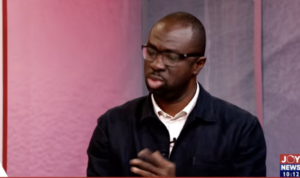
Executive Director of the Media Foundation for West Africa (MFWA), Sulemana Braimah, has warned that Ghana risks reintroducing the repealed criminal libel law “through the back door” if the police continue arresting people over alleged false publications instead of allowing civil legal processes to take their course.
Speaking on Joy FM’s Super Morning Show on Monday, July 20, during a discussion on press freedom following the one-year jail sentence handed to a TikToker for publishing false information, Mr Braimah said recent police actions resemble the criminal libel regime that Ghana abolished more than two decades ago.
He recalled the arrest of broadcaster Kwabena Bobie Ansah after he allegedly made false claims about former First Lady Rebecca Akufo-Addo.
“I remember when the police arrested Kwabena Bobie Ansah, and the claim was that he had put out information about the former First Lady, Mrs Rebecca Akufo-Addo, that some state lands had been acquired for a foundation and so on, and it was said to be false information,” he said.
Mr Braimah said the Media Foundation for West Africa opposed the arrest because there were established legal avenues for anyone who believed they had been defamed.
“Our position was that if the First Lady felt defamed, she had a choice to either go to the National Media Commission, or demand a retraction and apology, or do a rejoinder, or go to court and sue for defamation,” he explained.
“But for the police to storm a radio station, pick up a presenter on the basis that he had put out information that was false, was clearly untenable.”
According to him, such actions undermine the very purpose of repealing Ghana’s criminal libel law.
“Then really, what is the difference between not having the criminal libel law and having the criminal libel law?” he asked.
He explained that under the former criminal libel regime, cases involving allegedly defamatory statements became criminal matters prosecuted by the state rather than civil disputes between individuals.
“The essence of the criminal libel law would be that if you say something or you defame a minister, it becomes the Republic versus you instead of the minister versus you,” he said.
“We thought, why should we have a law that criminalises expression? And so we took it out.”
Mr Braimah said that the recent trend of police pursuing people over statements made in the media suggests Ghana is gradually returning to the same approach.
“If this continues, then we are back to criminal libel law through the back door. And I don’t think that is what we intended when we were repealing the criminal libel law,” he said.
Instead of criminal prosecution, he said that people who believe they have been defamed should seek civil remedies through the courts or alternative dispute resolution mechanisms.
“If people feel offended, they can go to court, and the court, at the end of the day, if it feels that what was done was defamatory, whatever sanctions can be imposed,” he stated.
Mr Braimah also questioned what he described as selective enforcement against individuals accused of spreading false information.
“People are sitting on the radio every day, in the name of political debate, peddling falsehoods about people every day. Is it because those ones are mainstream media, so the police don’t see them or they don’t hear them?” he asked.
He said that it would be impossible for the police to monitor every public statement made on radio, television, and social media.
“I don’t think that the police will have the capacity to police public commentary. That is the problem,” he said.
Mr Braimah therefore renewed his call for a comprehensive national framework to tackle misinformation instead of relying on arrests and prosecutions.
“The state must respond in terms of what is allowed, what is not allowed… the civil remedies are still available. If people feel offended and they think they want to go to court instead of the National Media Commission or demand retraction and apology, that option is there,” he said.
He also called for greater accountability for social media platforms, saying that many individuals spread abusive or false content from outside Ghana without facing any consequences.
“We need to begin to have a very serious conversation about the responsibilities of the platforms,” he said.
“People like Kelvin Taylor sit in the US, and they insult people here. And nothing can be done, it appears,” he said.
Mr Braimah questioned whether Ghana’s political class was genuinely committed to tackling abusive online content, claiming that some of the same people who condemn such conduct have celebrated individuals accused of engaging in it.
“When he came to town, what happened? He was like a hero to people in the ruling party today. Are we happy with what he does?” he asked.
He warned that relying on arrests and imprisonment would not stop the spread of misinformation because those responsible could simply relocate their operations abroad.
“If we don’t deal with these issues comprehensively, yes, we may think that we are arresting people today and jailing them. But the next thing that will happen is that somebody will set up something in Côte d’Ivoire or in the Netherlands and decide to use it to attack people and incite people,” he warned.