Kenya has called for African countries to take greater ownership of their health information systems, warning against fragmented digital platforms, duplicated investments and dependence on technologies developed outside the continent.
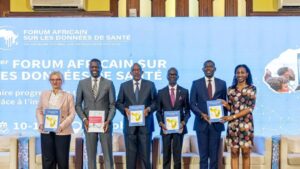
Kenya’s Cabinet Secretary for Health, Aden Duale, made the call on 10 November 2026 when he officially opened the First Africa Health Data Forum in Nairobi.
“For Kenya, digitisation and data are not simple enablers. They are the backbone of our universal health coverage,” he said.
The three-day forum, running until 12 November under the theme “Better Data, Better Health for All”, is convened by the World Health Organisation (WHO), the Kenya Digital Health Agency and Kenya’s Ministry of Health.
It has brought together more than 300 participants from 51 countries across the WHO African and Eastern Mediterranean regions, including government representatives, development partners, academics, civil society organisations and private-sector innovators.
The meeting is providing a platform for countries to share experiences, identify priorities and explore practical solutions for strengthening health information systems.
Health data are essential for understanding why people are dying, identifying emerging health threats and determining where healthcare services and resources are most urgently needed.
Kenya pushes for a unified patient health record
Addressing participants, Mr Duale outlined Kenya’s ambition to bring patients’ health information together through a unified digital system.
“So our vision is very simple: one patient, one longitudinal health record, which is accessible wherever that patient receives care,” he said.
He cautioned that declining external financing made it increasingly important for African countries to avoid fragmented systems and unnecessary duplication of investments.
“However, as external financing shrinks, Africa cannot afford fragmented systems, cannot afford parallel reporting and duplicated investments. Every dollar and every shilling must strengthen our national health information system,” he said.
The Cabinet Secretary also announced plans to establish a National Intelligence and Analytics Centre under the Digital Health Agency to strengthen the analysis of health data.
He emphasised the importance of timely information in healthcare decision-making, saying: “What gets measured is managed, and what gets measured in real time, we can act in real time.”
Mr Duale further challenged African countries to develop their own technological solutions rather than remain dependent on innovations produced elsewhere.
“However, Africa should not merely be a consumer of technologies developed elsewhere. We must become producers of solutions that respond to our own priorities and realities,” he said.
Kenya’s Ebola response demonstrates the value of health data
WHO Regional Director for Africa, Professor Mohamed Yakub Janabi, highlighted Kenya’s response to Bundibugyo Ebola Virus as an example of how reliable information can support public health interventions.
He said Kenya traced all 135 contacts of its first case, both within the country and internationally, while the eight contacts who subsequently tested positive were already in quarantine.
The experience, he said, demonstrated the importance of ensuring that information reaches the people responsible for taking action.
“Data did not replace people. It told people where to go, whom to call, and when,” Professor Janabi said.
“Good data turns alarms into actions. That only happens when the right information reaches the right people at the right time. Kenya has shown us what is possible when data and decisive actions meet,” he added.
His remarks highlighted the relationship between effective health information systems, disease surveillance and the ability of authorities to respond to public health threats.
WHO report exposes weaknesses in African health information systems
At the opening ceremony, Professor Janabi launched a new WHO report, The Maturity and Functionality of Health Information Systems in the WHO African Region.
The assessment, conducted in 2024 across 40 of the Region’s 47 Member States, gave health information systems an overall maturity score of 59 out of 100.
The findings indicate that many countries in the WHO African Region remain at an early stage in developing the systems and capacities needed to produce and use reliable health information.
The report’s launch brought attention to the need for stronger investment, institutional capacity and coordination to ensure that health information supports effective healthcare planning and delivery.
Director of Programme Management at the WHO Regional Office for Africa, Dr Abdourahmane Diallo, stressed that reliable information was also necessary to ensure accountability in public spending.
“A budget allocation is a commitment to the public. Governments need credible evidence of whether funding was used as intended and what it achieved,” he said.
He emphasised the importance of credible data in assessing whether health investments are delivering the intended results.
WHO’s efforts to strengthen access to health information across the continent also featured prominently at the forum.
In August 2026, the organisation launched the Regional Health Data Hub, a digital platform designed to bring together information from different health programmes in one place.
The platform is intended to strengthen access to health information and support more effective decision-making by countries.
Dr Benson Droti of the WHO Regional Office for Africa demonstrated how the platform works during the forum.
He clarified that the platform was developed for the benefit of Member States rather than as a WHO-owned system.
“It is not the WHO’s platform. It’s a platform built for the member states,” he said.
The initiative reflects efforts to make health information more accessible and useful to national authorities responsible for planning and managing healthcare services.
In a video message, WHO Director-General Dr Tedros Adhanom Ghebreyesus also emphasised the importance of African ownership and governance of health information.
“Crucially, Africa’s health data must be owned, governed, and used by African countries in the interests of their people,” he said.
WHO and development partners call for country-led action
In her welcome remarks, Dr Neema Rusibamayila Kimambo, WHO Representative to Kenya, said the forum should produce practical action rather than another set of recommendations.
“The aim of this Forum is not another set of recommendations. It is to listen to countries and act together, and WHO stands ready to align our support behind country priorities,” she said.
Development partners also highlighted the importance of ensuring that health information captures the needs of vulnerable populations, particularly children.
UNICEF Regional Director for Eastern and Southern Africa, Etleva Kadilli, said, “For UNICEF, behind every data, there is a child.”
Chief of Staff of the United Nations Economic Commission for Africa, Aboubakri Diaw, similarly stressed the consequences of failing to account for every child in national planning.
“A child who is not counted is a child who is not planned for,” he said.
Forum seeks practical roadmap for Africa’s health data systems
With two days of discussions remaining, countries and partners are expected to examine the changes needed to strengthen health information systems and translate national priorities into coordinated action.
The discussions will focus on identifying common challenges, aligning partner support with country priorities and developing plans for follow-up.
The forum is also expected to become a biennial meeting, providing an opportunity for countries to review progress every two years.
Closing his opening remarks, Kenya’s Cabinet Secretary for Health, Mr Duale, called for the meeting to produce concrete commitments and clearly defined responsibilities.
“Let us leave Nairobi with a very practical Africa Health Data Roadmap,” he said.
Adding that, “Let us leave Nairobi with a country-partner alignment matrix, with very clear responsibilities, clear timelines, and a way to track delivery.”