By Ramana Shareef
African countries and their international development partners have been urged to rethink the nature of their cooperation, with greater emphasis on economic transformation, local value addition, mutual interests and African ownership of development priorities.
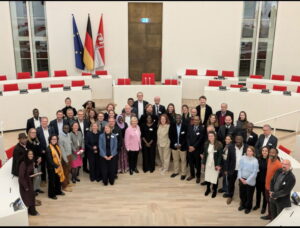
The call featured prominently at the Potsdam Africa Dialogues 2026, a two-day international conference held from 23rd – 24th November in Potsdam, Germany, under the theme “Transforming Partnerships? Africa and the Future of International Cooperation.”
Organised by the Development and Peace Foundation (sef:), the conference convened diplomats, policymakers, development experts, researchers, civil society representatives and business leaders to examine the future of international cooperation amid evolving geopolitical and economic conditions.
Former German Chancellor Olaf Scholz, delivering the opening keynote address, stressed the importance of acknowledging the historical foundations of relations between Africa and Europe when developing future partnerships.
Scholz, who currently serves as Co-Chair of the South-North Commission on Development, highlighted the enduring impact of colonialism and historical economic inequalities on contemporary international relations.
He also addressed challenges surrounding sovereign debt, development financing, international trade and the need to create conditions that enable African countries to expand their productive economic capacities.
The former Chancellor’s intervention comes amid renewed discussions in Germany about the future direction of its international development policy and the need to reform global development cooperation.

Africa must negotiate partnerships that advance its interests
Delivering the keynote address on the second day, Zambia’s Ambassador to Germany, H.E. Winnie Natala Chibesakunda, called for international partnerships that contribute to economic diversification, industrialisation, technology transfer and sustainable development.
She noted that changing global power relations and growing competition for Africa’s natural resources presented significant opportunities but also required African governments to exercise greater strategic judgement.
Drawing on Zambia’s experience, the Ambassador explained that longstanding diplomatic relationships could no longer be taken for granted, as international cooperation was increasingly influenced by economic interests and changing political priorities.
“The true test of a partnership is not how well it functions when interests converge and circumstances are favourable, but whether it can withstand political differences, adapt to changing realities and remain committed to shared objectives when cooperation becomes difficult,” she said.
Ambassador Chibesakunda stressed the need for African countries to negotiate investment arrangements that support domestic processing of natural resources, local value creation and the development of national industries.
She also called for meaningful African participation in international policy reform processes, including the work of the South-North Commission on Development.
Trust and transparency in development cooperation
Participants also examined concerns about the credibility of international development partnerships.
Dr. Anika Altaf, Executive Director of the INCLUDE Knowledge Platform for Inclusive Development Policies, presented research insights into African perceptions of European development cooperation.
She indicated that while African stakeholders valued international partnerships, concerns remained about unequal negotiating positions, perceived double standards and insufficient transparency regarding partners’ underlying interests.
Dr. Philani Mthembu, Executive Director of the South Africa-based Institute for Global Dialogue, highlighted the importance of South-South cooperation and strategic alliances in strengthening Africa’s influence in global governance.
He drew on South Africa’s experience during its G20 presidency to illustrate the value of cooperation among Global South countries, regional institutions and independent policy networks.
Private-sector engagement and local economic development
A separate panel discussion examined the role of international businesses in Africa’s development and the importance of aligning private investment with national development priorities.
The session brought together representatives of the German-African Business Association, Kowry Energy, Ziada Solutions, vocational training initiatives and the Africa Policy Research Institute.
Discussions focused on investment opportunities, skills development, technology transfer, local business participation and the need to establish economic relationships that deliver benefits to both African and European partners.
Joshua Kwesi Aikins, Head of the Economy and Society Programme at the Africa Policy Research Institute, contributed to discussions on strengthening reciprocal economic cooperation and ensuring that African interests and expertise are adequately reflected in development arrangements.
The issues discussed have particular relevance for Ghana, where efforts to promote industrialisation, diversify the economy and increase domestic processing of natural resources depend partly on the country’s ability to negotiate productive international partnerships.
Peace, community ownership and regional cooperation
The conference also highlighted the interconnected nature of peace, security and sustainable development.
Ottilia Anna Maunganidze, Head of Special Projects at the Institute for Security Studies, urged development practitioners to give greater recognition to local knowledge, community-led initiatives and the contributions of African diaspora networks.
“Peace is development, development is peace,” she stated, emphasising the importance of integrating security and development objectives.
Prof. Dr Christof Hartmann, Director of the Institute for Development and Peace at the University of Duisburg-Essen, highlighted the role of African regional and continental institutions in strengthening the continent’s collective influence in international affairs.
As part of the conference, participants visited the Brandenburg State Parliament, where they were received by its President, Prof. Dr Ulrike Liedtke.
The Potsdam Africa Dialogues are an established international forum for discussions on peace, regional cooperation and sustainable development in Africa. The 2026 edition received financial support from the German Federal Ministry for Economic Cooperation and Development (BMZ), with support from the German development cooperation agency GIZ.